Letters from Dr. Marlowe Finch · Ages 7–10

Six hundred meters down, my submersible loses power. Then the dark begins to glow.

— from Dr. Finch's first letter

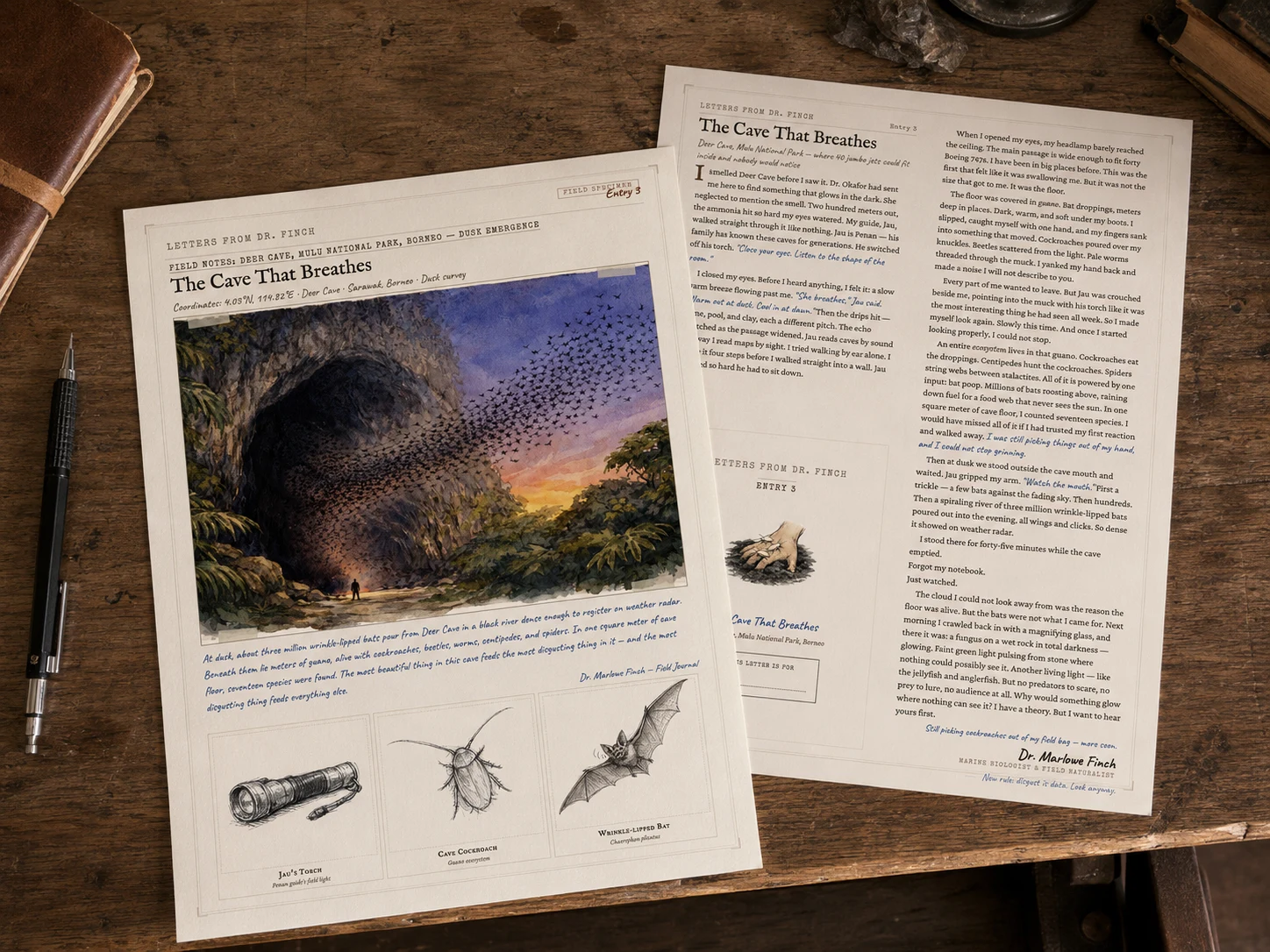
Twice a month, Dr. Marlowe Finch mails your child a letter from wherever she's working in the field. She treats an eight-year-old as a fellow scientist — because that's the fastest way to make one. No screen, no worksheet, no grade. Just the next envelope, and the wanting to know what's inside it.
Starts at Entry 1 regardless of when you subscribe. Cancel anytime.
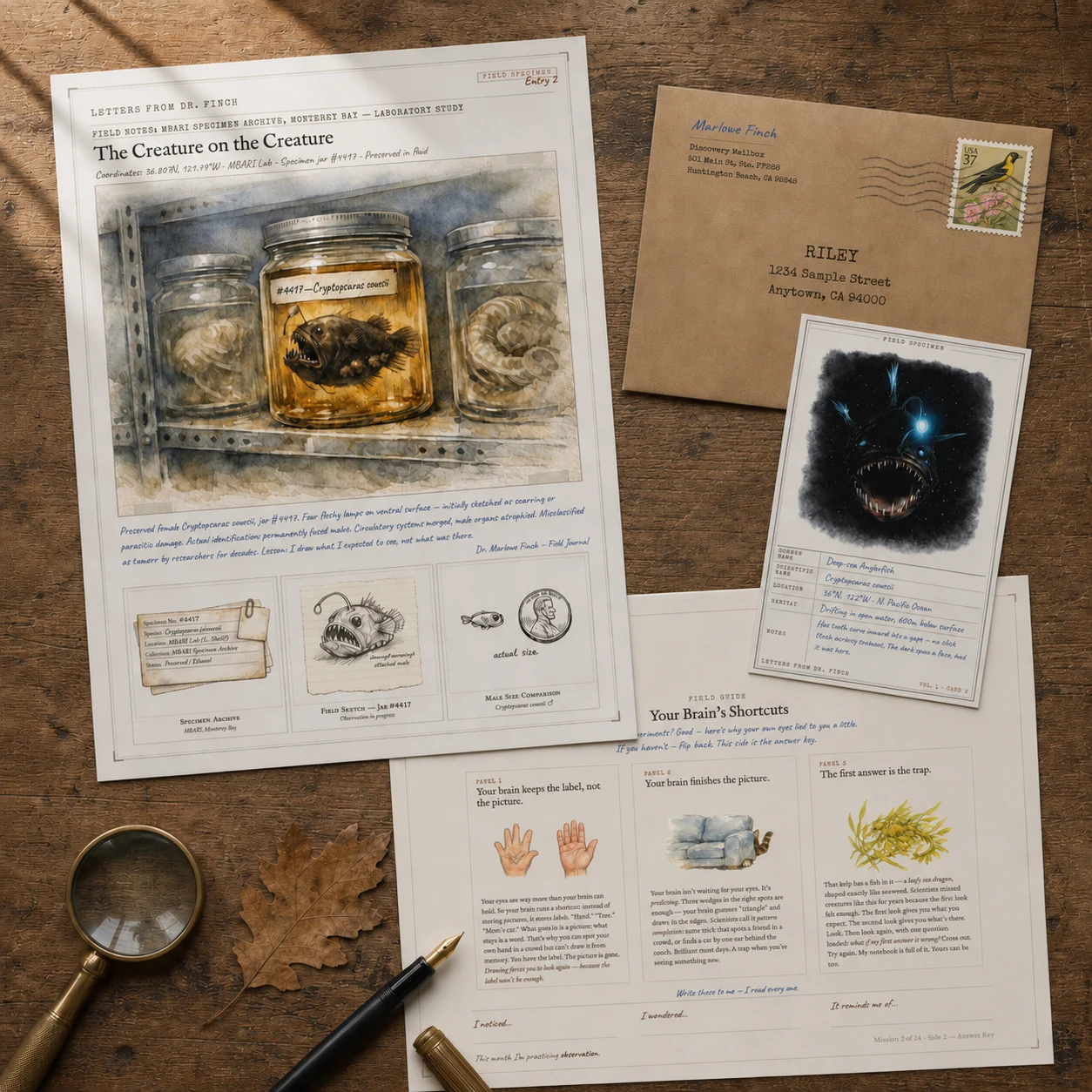
A Discovery Mailbox kit on a wooden desk: the Entry 2 letter 'The Creature on the Creature' showing a watercolor anglerfish specimen in a lab jar, a kraft envelope addressed to Riley, a deep-sea anglerfish specimen card, and a field mission sheet titled 'Your Brain's Shortcuts'. A magnifying glass, oak leaf, and fountain pen rest on the desk.
Mail, not an app. Twice a month, kept on a shelf. Twenty-four letters, in order. A twelve-month arc — each one builds on the last. Written for kids, treated as peers. Reads like a book, not a worksheet.
What arrives

Three things in every envelope.

Each mailing is a small field kit from Dr. Finch — a letter, a specimen card, and a field mission to do.

The Entry 1 letter on a wooden desk, showing the deep-sea hero illustration.
The letter

A dispatch from the field.

A story from wherever Dr. Finch is working, told in her own voice — the science woven into the telling, with a full page of original art facing the letter.
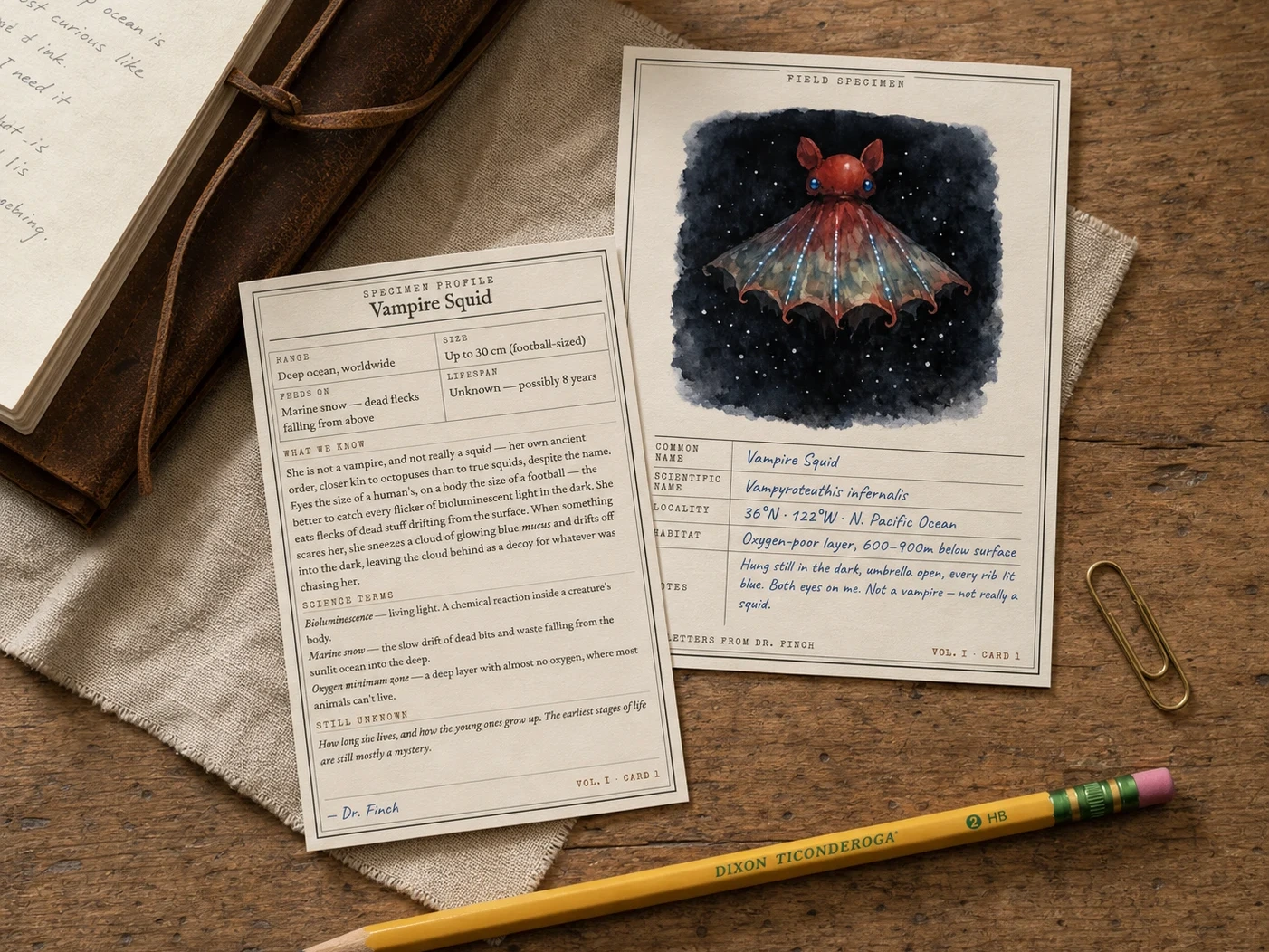
A vampire squid specimen card resting on linen, showing watercolor illustration and field-data table.
The specimen card

The specimen, up close.

The specimen from that month's letter, on its own card — illustrated front, field data and profile on the back. Twenty-four across the year, numbered.
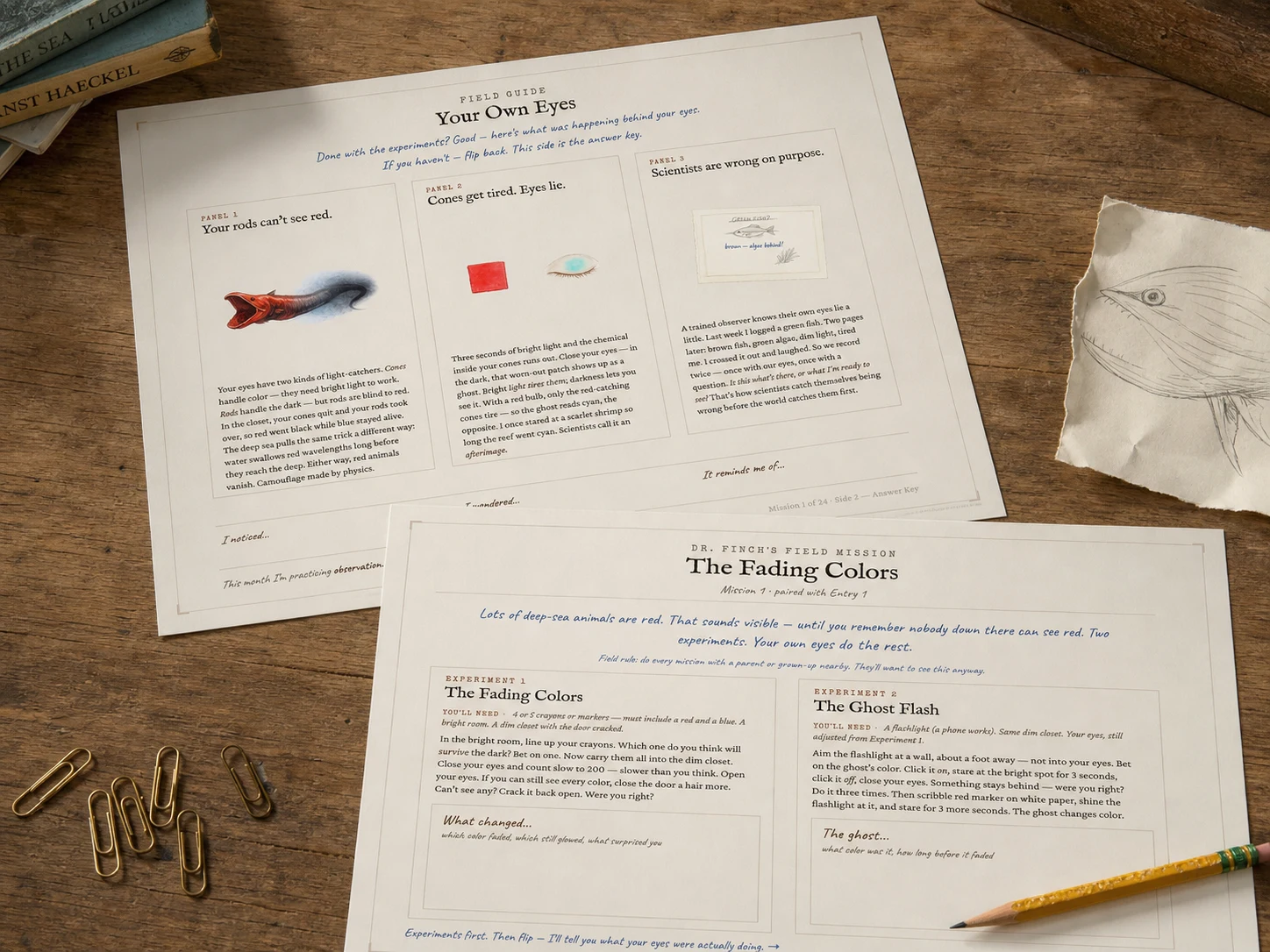
A landscape field-mission sheet on a wooden desk with a yellow pencil resting on it.
The field mission

Something to do.

A full-page working sheet — Dr. Finch asking for help with an observation or experiment, with room to sketch and write back.

The curriculum

A twelve-month arc, in six chapters.

The series builds a thinking skill every two months. The child never sees the curriculum — Dr. Finch just models it through her own work in the field. The skill shows up on the page; the textbook never does.

Months 1–2
Observation
Dr. Finch loses the lights in her submersible and finds out the dark wasn't empty. She sketches things she's looked at a hundred times and notices something new. Your child starts doing the same.
Months 3–4
Questioning
Observations become questions. Dr. Finch pulls a thread that doesn't lead anywhere, then pulls another. She models the kind of question worth chasing — not the kind a teacher would ask, the kind a kid does.
Months 5–6
Pattern
Two unrelated places, the same answer. Coral builds the way trees branch the way blood vessels distribute. Dr. Finch starts holding things side by side to see why nature picks the same solution twice.
Months 7–8
Systems
Nothing in nature changes alone. Dr. Finch traces what happens when one part of a system shifts — wolves leave a forest and the rivers change shape — and your child starts seeing connections instead of objects.
Months 9–10
Evidence
Dr. Finch is wrong about something. She figures it out, says so on the page, and revises. The most adult thing in the series happens here: a scientist publicly changes her mind. Your child learns what that looks like.
Months 11–12
Independence
By Month 11, Dr. Finch is asking your child for observations she can't make herself. By Month 12, she's writing back about what your child noticed. The series ends with the reader as the scientist.

Every subscriber starts at Entry 1, regardless of when they join. How it's made →

Who writes

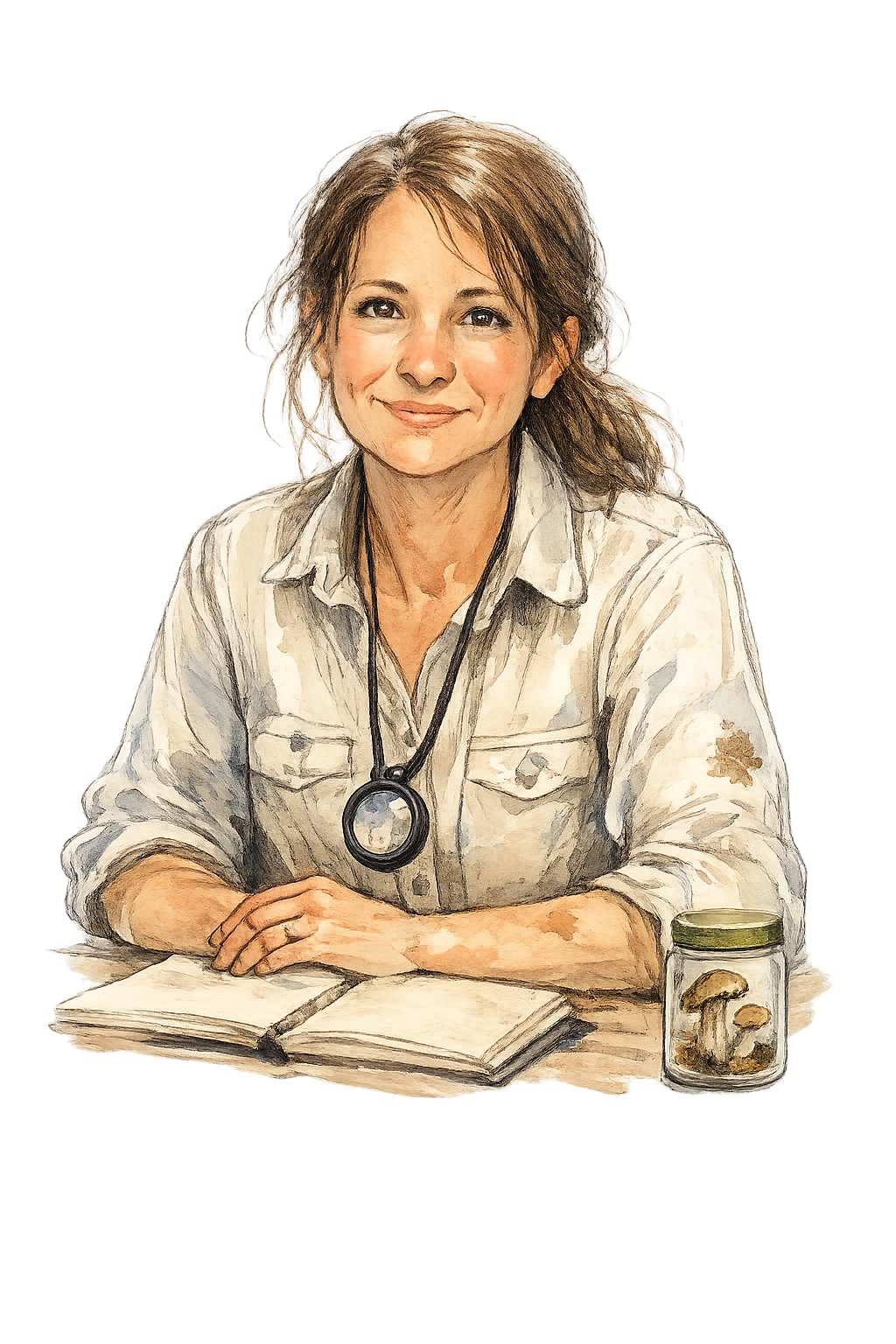
Dr. Marlowe Finch — marine biologist, and an occasional loser of car keys.

Dr. Finch is a marine biologist and field naturalist who follows questions wherever they lead — oceans, forests, caves, deserts, tundra. Each letter is a dispatch from somewhere she's working, in her voice.

She's also wrong sometimes, afraid of heights, and spills coffee on her field notes. She treats the reader as a fellow thinker, not a student. The whole thing is closer to a series of letters from a curious aunt than a worksheet from school.

Read a sample letter →
Subscribe

Two letters a month.

Everyone begins at Entry 1, no matter when you subscribe. Your first letter from Marlowe ships within a week of your order, addressed to your child by first name. After that, a letter is mailed on the 1st and the 15th of every month.
Monthly subscription

Two letters a month. Cancel anytime.
$14.99  / month
Billed monthly. US postage included.
  • Two letters per month
  • A specimen card and a field mission with every letter
  • Envelope addressed to your child by first name
  • Cancel anytime
Questions parents ask

Practical details.

What age is this for?
Designed for a curious 8-year-old reading independently. Works from about 7 to 10, sometimes older for a child who loves to read.
When does the first letter ship?
Within roughly a week of the day you subscribe. Your first envelope is Entry 1 of the series, addressed to your child by first name.
Can I cancel?
Yes — anytime. Request a billing-portal link from the Manage page and Stripe handles cancellation. No phone calls, no "why are you leaving" email.
Will my child actually read this?
We think so — the letters are written the way good kids' books are written, not the way curriculum is written. Read the sample and judge for yourself.

Read every question a parent has asked →